

You have the power to transform your blog into a traffic magnet by creating SEO-friendly posts that enhance your visibility in search engines. By implementing targeted keywords, optimizing your headings, and crafting engaging content, you can attract more visitors and encourage them to stay longer on your site. Structured formats and internal linking not only improve your SEO ranking but also enhance user experience. This guide will provide you with the imperative steps to ensure your blog content resonates with both search engines and your audience.
Key Takeaways:
- Keyword Research: Conduct thorough research to identify relevant keywords that your target audience is searching for. Use tools like Google Keyword Planner or SEMrush to find popular keywords and incorporate them naturally into your content.
- On-Page SEO: Optimize your blog posts by using proper header tags (H1, H2, H3), including meta descriptions, and ensuring that images have descriptive alt text. This helps search engines understand your content structure and context.
- Quality Content: Focus on creating valuable and engaging content that fulfills user intent. Longer, informative posts typically perform better in search rankings, so aim for at least 1,000 words while ensuring readability and coherence.
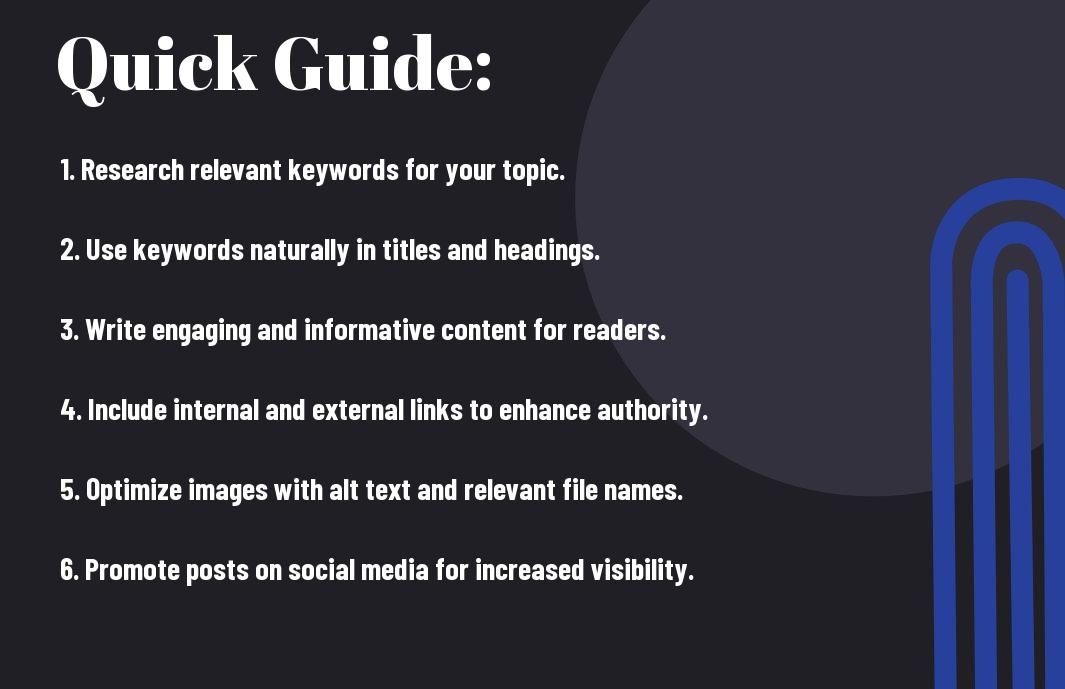
Understanding SEO-Friendly Blog Posts
While creating content, it’s vital to grasp the concept of SEO-friendly blog posts. These posts are designed to attract higher rankings on search engine results pages (SERPs), making your content more visible to potential readers. By focusing on SEO techniques such as keyword usage, quality content, and proper formatting, you can effectively increase organic traffic to your blog, ensuring your message reaches a wider audience.
What Makes Blog Posts SEO-Friendly
Little details matter when it comes to crafting SEO-friendly blog posts. Effective use of relevant keywords, engaging title tags, and meta descriptions can significantly improve your content’s search engine visibility. Additionally, optimizing images and using internal and external links helps search engines understand your content better, thus boosting your overall rankings.
Importance of SEO in Blogging
SEO friendly blog posts enhance your ability to connect with your target audience. With effective SEO strategies, you not only improve your site’s visibility but also drive a greater amount of organic traffic. This can lead to higher conversion rates and a stronger online presence, amplifying the effectiveness of your content marketing efforts. By understanding and implementing SEO best practices, you position your blog as a valuable resource, attracting readers consistently and establishing your authority in the niche.
Make no mistake: the significance of SEO in blogging extends beyond mere numbers. Implementing strong SEO practices can ensure that your blog content is not only discoverable but also resonates with your intended audience. An enhanced online presence ultimately leads to greater engagement and loyalty, allowing you to cultivate a dedicated following. In a competitive digital landscape, a well-optimized blog sets you apart, making your content a go-to resource for readers seeking valuable information.
Types of SEO-Friendly Blog Posts
Assuming you want your blog to rank well, it’s important to understand the various formats of blog posts that can enhance your SEO strategy. Here are different types of SEO-friendly blog posts you can consider:
| List Posts | Engaging lists of topics that are easy to read and share. |
| How-To Guides | Step-by-step instructions providing valuable insights. |
| Infographics | Visual content that simplifies complex information. |
| Interviews | Expert insights that add authority to your content. |
| Product Reviews | In-depth evaluations that help your audience make decisions. |
Any of these types can be effective in drawing traffic when optimized properly.
List Posts
Assuming you want to create engaging content, list posts can be a powerful format. They provide concise information that is easily digestible for readers, which can lead to increased sharing and backlinks. A catchy title with numbers can attract clicks, helping your blog reach a wider audience.
How-To Guides
To effectively help your audience, How-To guides are an excellent option. They offer in-depth instructions on accomplishing specific tasks, making them highly valuable for readers seeking to solve problems or learn new skills.
Understanding how to create How-To guides can significantly enhance your blog’s performance. These posts not only showcase your expertise but also draw traffic when optimized with relevant keywords, meta tags, and proper formatting. Include visual aids to complement your steps for increased engagement. This format encourages reader interaction, as users often bookmark or share guides they find helpful, boosting your site’s authority and visibility in search engines.

Step-by-Step Guide to Creating SEO-Friendly Blog Posts
Keep this guide handy as it breaks down the vital steps to create SEO-friendly blog posts. Follow the table below for a streamlined approach to optimizing your content effectively.
| Step | Description |
|---|---|
| 1. Keyword Research | Identify relevant keywords to target in your blog content. |
| 2. Structuring Your Content | Create a well-organized layout for readability and SEO benefits. |
Keyword Research
For effective SEO, you must conduct thorough keyword research. Utilize tools like Google Keyword Planner or SEMrush to find keywords with high search volume and low competition. Select primary keywords to include in your post while ensuring they naturally fit within your content, enhancing discoverability.
Structuring Your Content
Guide your readers with a well-structured format that improves engagement. Start with a captivating introduction, followed by the main body where you address key points in logically sequenced headings and subheadings. Ending with a strong conclusion encourages readers to take action.
Posts are more likely to rank higher in search engines when you structure them effectively. Keep paragraphs concise and utilize bullet points for clarity. Incorporate internal and external links within the text while using H1, H2, and H3 tags appropriately to enhance readability and help search engines index your content better. Your ultimate goal is to create a valuable experience for your readers while strategically aligning your writing with SEO practices.
Essential Factors for SEO Optimization
Many elements contribute to effective SEO optimization that ensures your blog posts rank well in search engines. Key factors include:
- Keyword research
- Content quality
- User experience
- High-quality backlinks
- Mobile optimization
After implementing these strategies, your content will stand out. For additional insights, check How to write SEO blog posts that rank and convert (8 tips).
Title Tags and Meta Descriptions
Meta descriptions offer a brief yet powerful summary of your content. You should craft engaging title tags and meta descriptions that incorporate your main keywords and compel users to click through to your articles. Including a clear call to action can significantly improve your click-through rates.
Image Optimization
Clearly, optimizing images is an important aspect of your SEO strategy that can enhance performance and user engagement. Your images should have descriptive file names and use alt text that incorporates relevant keywords. Not only does this help search engines understand your content, but it also improves accessibility for users.
It is vital to compress images to reduce loading times, which can positively impact user experience. Be cautious of excessive file sizes as they can slow down your site, harming your search rankings. Consider using formats like WebP or JPEG for balance between quality and efficiency. Engaging and well-optimized images not only enhance your blog’s visual appeal but also contribute to better overall SEO performance.

Tips for Writing Engaging and SEO-Friendly Content
For effective blog content, you should focus on creating engaging and SEO-friendly material. Consider these strategies:
- Utilize target keywords naturally throughout your content.
- Incorporate multimedia elements to enhance engagement.
- Write in short, clear sentences for better readability.
- Encourage interaction by posing questions to your readers.
Recognizing the importance of these techniques can significantly improve your blog’s performance. For more tips, check out this guide on How to Write a Blog Post That Is Optimized for SEO [2024].
Crafting Catchy Headlines
If you want to draw readers in, crafting catchy headlines is vital. Your headline serves as the first impression and should contain your main keywords while sparking curiosity. Use numbers, questions, or compelling adjectives to create a sense of urgency and encourage clicks.
Using Internal and External Links
Clearly, integrating internal and external links within your blog posts enhances both user experience and SEO value. Internal links guide readers to other relevant content on your site, keeping them engaged for longer, while external links to authoritative sources help build credibility.
Engaging your audience through thoughtful linking strategies can significantly boost your blog’s visibility. Internal links help readers navigate your site, fostering a deeper connection with your content, while external links provide valuable references, enhancing the trustworthiness of your blog. Make sure to link to reputable sites and integrate links naturally within your text to avoid disrupting the flow of your writing.

Pros and Cons of SEO Practices in Blogging
Despite the increasing necessity for effective SEO tactics in blogging, it’s imperative to weigh both the advantages and disadvantages. Below is a breakdown of the pros and cons:
| Pros | Cons |
|---|---|
| Improves visibility in search engines | Can lead to keyword stuffing |
| Boosts organic traffic | May create unnatural writing styles |
| Enhances user experience | Requires ongoing effort |
| Increases credibility and authority | Potentially high competition |
| Provides measurable results | Can be complex to implement |
For more insights, check out this discussion on Is there any way of writing SEO friendly Blog posts without ….
Advantages of SEO Optimization
For you, the advantages of SEO optimization are numerous. It fundamentally enhances the visibility of your blog, making it easier for potential readers to find your content online. An effective SEO strategy not only drives organic traffic but also builds credibility, allowing you to establish your blog as an authority in your niche.
Potential Drawbacks
With the benefits of SEO come some potential drawbacks that you should consider. Engaging in SEO practices may lead you to over-optimize your content, resulting in keyword stuffing which negatively affects readability. Furthermore, the energy required to maintain a competitive edge in SEO can be time-consuming and might detract from creative expression.
The inherent challenge of a continuously evolving SEO landscape means that you must stay updated on best practices to avoid penalties from search engines. The risk of compromising content quality for the sake of rankings can alienate your audience. Balancing SEO techniques while retaining your authentic voice in writing is vital; avoid making content feel forced or unnatural just for the sake of optimization. A thoughtful approach allows you to enjoy the benefits of SEO without succumbing to its potential pitfalls.
To wrap up
With these considerations in mind, you can effectively create SEO-friendly blog posts that not only attract search engine traffic but also engage your audience. Focus on crafting valuable, well-structured content with relevant keywords and optimized headings. Prioritize readability and incorporate effective internal and external links to enhance user experience. By consistently applying these strategies, you can boost your blog’s visibility and establish your authority in your niche.
FAQ
Q: What are the key elements of an SEO-friendly blog post?
A: An SEO-friendly blog post includes several key elements: 1. Keyword Research: Identify relevant keywords that your target audience is searching for. Use tools like Google Keyword Planner or Ahrefs to discover these keywords and integrate them naturally throughout your content. 2. Compelling Title: Craft a title that includes the primary keyword and captures the reader’s attention. Aim for a title length of around 60 characters to ensure it displays correctly in search engine results. 3. Headers and Subheaders: Use headings (H1, H2, H3) to structure your content. This not only helps with readability but also signals to search engines what your post is about. Include keywords in these headings where appropriate. 4. Internal and External Links: Include links to other relevant blog posts on your site (internal links) and authoritative sources (external links) to enhance credibility and encourage readers to explore more of your content. 5. Meta Description: Write a concise and engaging meta description containing your primary keyword. This appears in search results and can influence click-through rates. 6. Optimize for Readability: Use short paragraphs, bullet points, and images to break up the text. Aim for clarity and simplicity to keep readers engaged.
Q: How do I choose the right keywords for my blog posts?
A: Choosing the right keywords involves several steps: 1. Identify Your Audience: Understand who your target readers are and what topics interest them. This helps to tailor your keyword selection. 2. Use Keyword Research Tools: Leverage tools like SEMrush, Moz, or Ubersuggest to discover keywords relevant to your niche. Look for keywords with a balance of search volume and competition. 3. Analyze Competitors: Review what keywords your competitors are ranking for. This can provide insights into keywords that may be valuable for your blog. 4. Long-Tail Keywords: Focus on long-tail keywords (phrases typically containing three or more words). They are generally less competitive and more specific, often resulting in higher conversion rates. 5. Search Intent: Consider the intent behind the keywords. Determine whether users are looking for information, products, or services and tailor your content to meet that intent.
Q: How can I promote my SEO-optimized blog posts effectively?
A: Promoting your SEO-optimized blog posts can be done through various channels: 1. Social Media Sharing: Use platforms like Facebook, Twitter, LinkedIn, and Instagram to share your blog posts. Create shareable graphics and engaging captions to draw attention. 2. Email Marketing: Include links to your blog posts in newsletters or dedicated email campaigns. Encourage subscribers to read and share your posts. 3. Guest Blogging: Write guest posts for established blogs in your niche. Include links back to your blog, which can drive traffic and improve SEO. 4. Online Communities: Engage in forums or online communities related to your niche, such as Reddit or Facebook groups. Share your insights and include links to your posts when appropriate. 5. Search Engine Optimization: Continually adjust and enhance your posts based on performance data. Monitor metrics through Google Analytics to understand what works best, and iterate on your strategy accordingly.