

Over time, mastering on-page SEO can significantly improve your website’s visibility and user experience. In this post, you’ll discover the top 5 factors that impact your site’s performance. From optimizing title tags and meta descriptions to effective use of headings and internal linking, understanding these elements will empower you to enhance your content strategy. Dive in to learn how you can boost your search engine rankings and draw more traffic to your site!
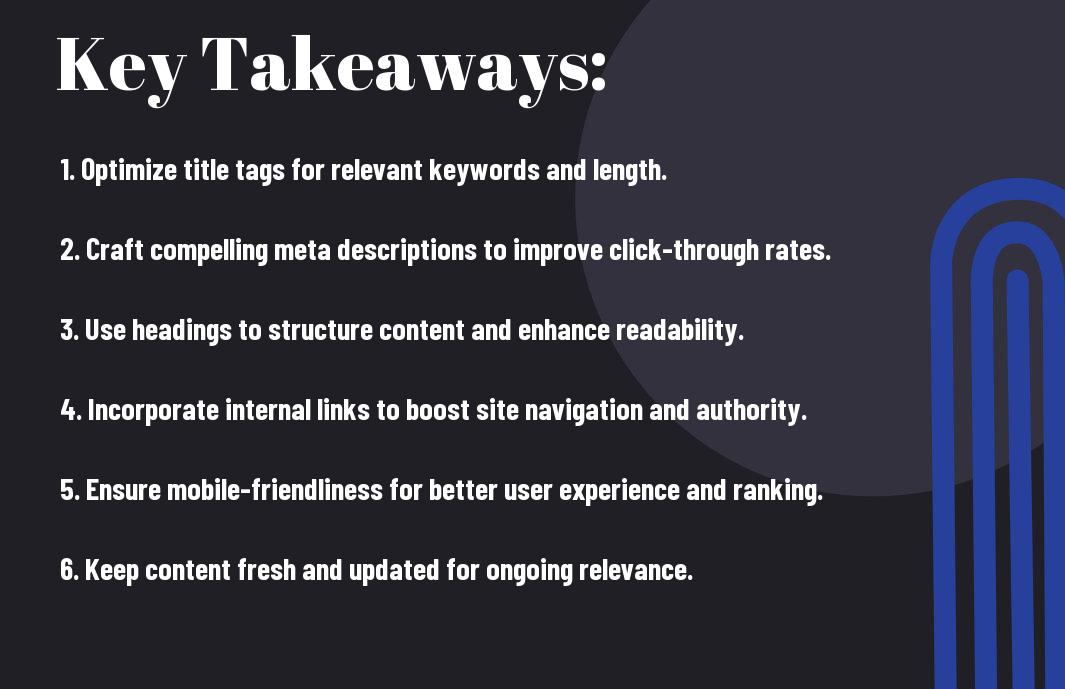
Key Takeaways:
- Title Tags play a vital role in improving search visibility, as they summarize the page content for both users and search engines.
- Meta Descriptions should be engaging and informative, as they influence click-through rates from search engine results pages.
- Internal Linking helps distribute page authority and enhances user navigation, ensuring visitors can easily find related content on your site.
Keyword Optimization
Your on-page SEO strategy hinges on effective keyword optimization. By targeting the right keywords, you can improve your content’s visibility in search engine results. This involves choosing keywords that align with your audience’s search intent, ensuring that your content meets their needs and drives organic traffic to your site.
Importance of Keywords
Among the myriad of factors influencing your site’s performance, keywords serve as the foundation for search engine optimization. They help search engines understand the relevance of your content in relation to user queries. When you utilize the right keywords, your chances of ranking higher on search engine results pages increase significantly.
Keyword Placement Techniques
After identifying target keywords, it’s imperative to deploy them strategically across your content. This includes placing keywords in titles, headers, and throughout the body text while maintaining a natural flow. Effective placement not only enhances SEO but also improves readability for your audience.
For instance, you should incorporate your primary keyword in the title tag and the meta description to signal the relevance of your content. Additionally, using keywords in headings and subheadings helps search engines better understand your content structure. Aim for a keyword density of about 1-2% to avoid keyword stuffing, which can negatively impact your ranking. Always prioritize contextual relevance over sheer volume—this enhances user experience while ensuring search engines see your content as valuable.
Title Tags
Some of the most important elements of on-page SEO are title tags, which play a significant role in how search engines rank your pages. A well-crafted title tag not only helps improve your visibility in search results, but it also influences click-through rates. Ensure that your title tags are unique for each page and accurately reflect the content, as this can lead to higher engagement and a better user experience.
Crafting Compelling Title Tags
Between the need to be informative and entice clicks, crafting compelling title tags is both an art and a science. Start by including your primary keyword, and consider adding a value proposition or a call to action to engage your audience. A well-written title tag should create intrigue while clearly conveying what visitors can expect from your content.
Best Practices for Title Tags
Tags should typically be kept between 50-60 characters to ensure they display correctly in search results. You should place your primary keyword near the beginning for better visibility and consider using brand names for recognition. Avoid keyword stuffing, as this can negatively impact your SEO performance.
Another best practice is to make each title tag unique for every page to prevent confusion among search engines and users alike. Using action-oriented language or emotional triggers can also help improve click-through rates. Additionally, keep in mind that search engines display around 50-60 characters—titles longer than this may be cut off, so it’s important to stay within this limit for maximum effectiveness.
Meta Descriptions
Many webmasters underestimate the importance of meta descriptions in on-page SEO. These brief snippets of text appear under your page title in search engine results, offering users a glimpse of what to expect. To learn more about optimizing your SEO strategy, check out the Top 7 On-Page SEO Ranking Factors 2024.
Writing Effective Meta Descriptions
Between engaging your audience and aligning with search intent, writing effective meta descriptions is imperative. Aim to create descriptions that entice clicks while accurately summarizing your content. A well-crafted description can significantly improve your click-through rate, so focus on clarity and relevance.
Meta Description Length and Structure
Below 160 characters, your meta description needs to be concise yet powerful. Search engines typically display only the first 150-160 characters, so it’s imperative to convey your message effectively within this limit. Aim for clarity and directness to capture user interest.
Structure your meta descriptions by beginning with a strong call to action. Use actionable language and highlight key benefits of your content. Also, consider including relevant keywords to improve search visibility. Your description should not only inform but also motivate users to click, making them feel like they would be missing out if they didn’t.
Header Tags
Now, understanding header tags is imperative for optimizing your content for on-page SEO. They help search engines understand the structure and hierarchy of your content, ultimately impacting your rankings. For a deeper probe on-page factors, check out What Are On-Page Ranking Factors For SEO?
Role of Header Tags in SEO
Beside enhancing user experience, header tags signal to search engines which content is most important. Proper use of header tags can enhance your readability and aid in indexing, providing both clarity and relevance.
Structuring Content with Headers
Beside improving readability, structuring your content with header tags allows you to create a logical flow throughout your article. Utilizing tags like H1, H2, and H3 helps you break down complex topics, making it easier for readers to scan your content.
Role of header tags cannot be understated. They not only improve user engagement by providing clear sections but also enhance SEO performance by allowing search engines to quickly grasp the topic of your content. When you strategically use header tags, you guide your readers through your article, enabling them to find relevant information efficiently. This structured approach can significantly reduce your bounce rate and keep visitors on your page longer.
Internal Linking
Keep in mind that internal linking plays a significant role in enhancing your on-page SEO efforts. By strategically linking to other pages on your site, you can improve navigation, increase the time users spend on your site, and help search engines crawl your content more effectively. This simple yet powerful technique not only boosts user experience but also enhances your site’s overall authority.
Benefits of Internal Linking
Above all, the benefits of internal linking are manifold. It helps distribute link equity throughout your site, guiding visitors and search engines alike to your most valuable content. Improving user experience by providing relevant links encourages longer sessions, which may lead to higher conversion rates. Furthermore, internal links can reduce bounce rates, contributing to more positive site metrics.
Strategies for Effective Internal Linking
At the heart of effective internal linking are several key strategies that you can implement. You should focus on creating a logical structure, using relevant anchor text, and prioritizing high-traffic pages. Ensure that your internal links offer value and context to your readers, leading them naturally from one piece of content to another.
Strategies for effective internal linking include mapping out your content structure to identify the best links, using descriptive anchor texts that reflect the destination content, and regularly auditing your links to remove broken connections. It is also beneficial to link to important pages that deserve more visibility, ensuring that users can easily navigate to high-value assets. Lastly, aim for a natural flow in your linking to keep users engaged, as overloading pages with links can be overwhelming.
To wrap up
The top five on-page SEO factors you need to know—title tags, meta descriptions, headings, and internal linking—are imperative for optimizing your content. By focusing on these elements, you can enhance your site’s visibility in search results, improve user experience, and ultimately increase traffic. Take the time to implement these strategies effectively to ensure that your audience finds and engages with your content. Prioritize these on-page SEO practices to establish your authority in your niche.
FAQ
Q: What are the top 5 on-page SEO factors that can impact my website’s ranking?
A: The top 5 on-page SEO factors include: 1) Title Tags: Optimizing title tags with relevant keywords helps search engines understand the content of your page. 2) Meta Descriptions: Crafting compelling meta descriptions can improve click-through rates by providing a summary of the page’s content. 3) Headings: Using proper heading hierarchy (H1, H2, H3) aids in organizing content and emphasizing key points, making it easier for users to scan the page. 4) Internal Linking: Incorporating internal links connects related content, enhancing user navigation and distributing page authority. 5) Content Quality: High-quality, relevant content that answers users’ queries is important for SEO as it encourages longer visits and shares.
Q: Why are title tags important for on-page SEO?
A: Title tags play a significant role in on-page SEO because they provide the first impression of a webpage in search results. A well-optimized title tag with targeted keywords can improve visibility in search engines, making it easier for potential visitors to find your content. Additionally, title tags establish the context of the page, which aids in enhancing user engagement as users are more likely to click on titles that match their search intent.
Q: How can internal linking benefit my website’s SEO?
A: Internal linking benefits SEO in several ways. Firstly, it helps to guide users through your website, allowing them to discover related content and improving their overall experience. Secondly, internal links distribute page authority across your site, which can boost the rankings of linked pages. Lastly, using descriptive anchor text in internal links enhances contextual relevance, helping search engines understand the relationship between different pages and improving the site’s overall SEO performance.